Projects > SIM App Global...
Global MedTech: The SIM App Story
Transforming an undocumented third-party demo into a scalable, medically aligned global platform through research, systems thinking, and cross-functional governance.

Role
Sr UX Lead

Team
1 UX lead, 2 designers, 1 Content Strategist, 1 technical Writter & 1 Localization Engineer

Tools
Figma, Maze, Miro, Jira, Figma Maker & Mobbin

THE CHALLENGE
A redesign of a medical simulation platform
The SIM App was used globally to demonstrate how the Omnipod insulin pump system works.
When I joined the project, the SIM App had already been released in the United States and France.
However, the product's internal structure revealed several risks.
The application had been built by a third party using static storyboards as development references. As a result, many flows were implemented based on interpretation rather than documented behavior.
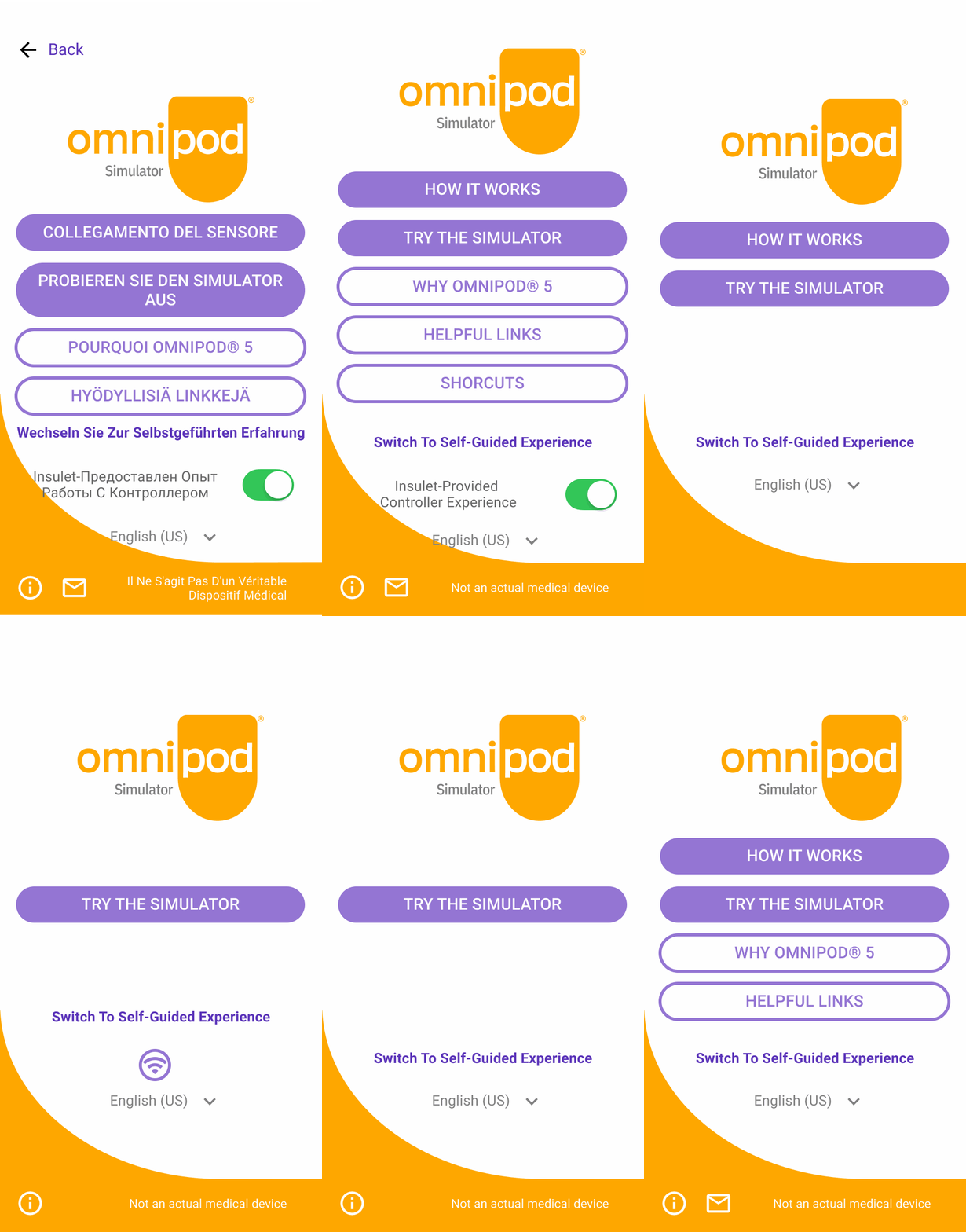
Legacy Architecture — Separate regional builds.
Key problems included:
• No product documentation or defined user flows
• Inconsistent UI behaviors across features
• Demo scenarios that did not match the real medical application
• Localization limitations that prevented expansion to new markets
• Multiple regional builds that required separate releases
At the same time, the business was preparing to expand the product to additional countries.
My role was to stabilize the product, uncover real user needs, and redesign the architecture to enable the platform to scale globally.
PRODUCT AUDIT
Understanding the system before redesign it
The goal was to understand how the application actually worked, identify inconsistencies, and define a plan to stabilize the product.

Previous Architecture
The inherited 3rd-party architecture was built on hard-coded redundancy. Because localization and product logic were tied directly to each country’s binary release, every update required a massive, non-scalable manual effort for 12+ regions. My audit uncovered critical discrepancies in which the 'demo' behavior did not align with real-world medical safety standards.
I architected a Scalable Configuration Architecture that moved logic from code to the system. By introducing a dynamic 'Logic Hub,' the app now loads correct medical scenarios, UI layouts, and localizations based on three simple inputs: Country, Language, and Device OS.
This removed release fragmentation, eliminated multiple bug sources, and created a future-proof foundation for global deployment.

After architecture proposed
User Research & Insights
To better understand how the application was used in practice, I helped lead a research initiative in collaboration with the UX designer and the UX Research team.
The study included:
-
10–15 discovery Cross-regional interviews
-
Follow-up validation sessions with defined user groups
-
Review of App Store comments and internal feedback
-
Usability testing of early architectural concepts
-
Discovered real users (Sales Reps, Educators, HCPs, Support).
-
Key insights (user confusion, missing features, compliance concerns).
-
How research drove the direction.

Users input and Design strategy proposal
I translated raw international research into a 4-pillar Design Strategy. By synthesizing feedback from diverse markets, I identified a critical safety gap (Simulation vs. Reality) and a technical bottleneck (Lack of OS parity). This board served as our 'North Star,' aligning the 6-person team and stakeholders on the architectural pivot required for a successful global release.

Configuration Engine proposal
Technical & Regulatory Alignment
To ensure medical accuracy:
-
Used FDA-submitted documentation as the source of truth
-
Collaborated with instructional design and product leads
-
Validated scenarios against real product versions
-
Designed architecture adaptable to country-specific requirements
-
Solved localization edge cases:
-
Time format differences (Canada vs France)
-
Decimal separators
-
Unit-of-measure selection in Germany
-
Text wrapping & layout behavior
-
To solve for global scalability, I architected a configuration-driven system. This demo shows how a single codebase dynamically adapts UI strings, regional medical units (mg/dL), and platform-native navigation based on user parameters—eliminating the need for separate country releases and reducing QA cycles by 66%.
Systems & Governance
To scale effectively, I implemented structural changes:
-
Introduced a UX Review stage within the Agile workflow
-
Created centralized Figma documentation as a single source of truth
-
Defined localization governance with certified medical terminology
-
Clarified cross-functional responsibilities between UX, Dev, QA, and Localization

Visual Layout - 3 libraries
Before:
-
Google-translated strings
-
Unclear UI behavior in other languages
-
Inconsistent medical terminology
-
Daily clarification meetings
After:
-
Medically aligned string catalog
-
Defined UI behavior for multilingual wrapping & formatting
-
Country-specific logic (e.g., German unit of measure differences)
-
Structured sprint-based clarification
I built a dedicated 'SIM Design System' library that reconciled the conflict between medical accuracy and simulation clarity. This modular system enabled a 6-person team to produce medically accurate demos for 12+ countries while ensuring users never confused the training environment with the live medical device.
OUTCOMES
Measurable Impact
-
Reduced QA Lifecycle by 66%: Successfully dropped the testing script preparation time from 3 months down to 1 month by standardizing the Figma-to-Dev delivery framework.
-
Zero-Delay Global Launch: Facilitated the simultaneous release of the Omnipod 5 simulator across 12+ countries and 7+ languages (including Germany, Italy, and France).
-
Scaled the UX Function: Grew the team from a solo lead role to a multidisciplinary group of 6 specialists, including UX Designers, Localization Leads, and Technical Writers.
-
Risk Mitigation through Research: Leveraged international Affinity Mapping to identify and resolve a high-stakes "Simulation Confusion" safety risk, resulting in the creation of a new architectural standard.
-
Modular Architecture Pivot: Replaced a brittle legacy system of 12+ manual builds with a single, configuration-driven engine that dynamically loads UI and medical logic based on user input.
-
Future-Proof Foundation: Established a scalable platform that now supports the entire future product roadmap, including upcoming releases for "Matterhorn" and "Moonshot".
Reflection & Growth
-
Research isn’t a one-off—continuous investigation drives real impact
-
Strategic leadership means building resilient systems, not quick fixes
-
Effective leadership is about enabling others to deliver at scale, not doing everything alone
Detailed case study, exact metrics, and clinical documentation are available for private walkthrough during interviews to respect NDA and client privacy.