Projects > Business Platform...
Global Sales Operations: Research-Driven Strategy for Financial Systems
How do you design a single tool that works for a Finance Approver in Australia, a Sales Lead in the UK, and a Product Owner in Scotland? As the Senior UX Designer on this global initiative, my mission was to bridge the gap between complex business logic and user-centered design, ensuring that 'Deal Pricing Management' was as intuitive as it was accurate.
Synthesizing complex financial requirements into a unified digital solution for a multidisciplinary team spanning 5 time zones.

Role
Sr. UX Designer

Team
UI/UX Designers, UX Lead, Dev, PO and Scrum Master.

Tools
Sketch, Adobe Cloud, InVision, Optimal Workshop, excel and othe microsoft tools.

CONTEXT
Complexity at Scale
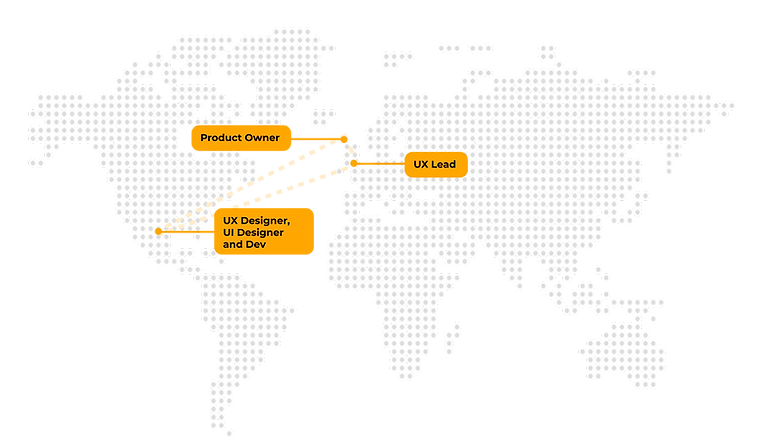
Global Team Map.
The project involved two massive ecosystems: OMS and DPM (Deal Pricing Management). These tools are the backbone of the company’s sales engine—used to estimate costs, margins, and staffing for global projects.
The Hurdles
-
Geographic Variance: The tool had to handle diverse tax laws, currencies, and labor rates across the UK, Nordics, and North America.
-
Disconnected Workflows: The previous process was fragmented, leading to friction between the sales teams and the delivery leads.
-
The 'Administrative' Trap: Research showed that for smaller deals, the tool was becoming a burden rather than a help."
FOUNDATION
Research as a Business Driver

Voice of the User Cards
I believe that research is the base of all good design, but its execution must align with business requirements. To solve the 'Deal Pricing' puzzle, I conducted a deep-dive discovery phase to validate our assumptions.
Key Research Actions
-
Stakeholder Deep-Dives: Conducted 33 semi-structured interviews with 9 different roles across 7 countries.
-
Business Logic Audit: Analyzed the 'DPM User’s Handbook' and 'Deal Shaping' documentation to translate financial rules into user flows.
-
User Personas Architype update: By interviewing regional Client Leads, I uncovered that the 'Solution Plan' was being bypassed for smaller deals—a critical insight that changed our design requirements.

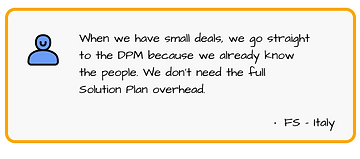
Data is only valuable if it’s actionable. I synthesized our 33 interviews into a comprehensive Persona Framework. This allowed the development team in Mexico to understand the 'Human' on the other side of the screen.
IMPLEMENTATION
Translating Insights to Design
The research directly influenced the product architecture. We moved away from a 'linear' process and implemented a logic that respected the user's context.
Strategic Implementations:
-
The "Express Path": Based on the interviews, we designed a simplified flow for smaller deals (2 people / 2 months) to reduce administrative friction while maintaining data integrity.
-
Staffing Model Integration: I worked with the UI team to ensure the 'Avanade Estimating Model' (AEM) import was seamless, allowing users to move from 'Planning' to 'Pricing' with zero data loss.
-
Cross-Time-Zone Alignment: I acted as the 'Research Source of Truth' for the Mexico-based Dev team, ensuring that every PBI (Product Backlog Item) was rooted in a validated user need.

Test result snapshot
%2015_05_18.png)
First click result snapshot
Research findings were synthesized to identify usability gaps, navigation challenges, and mismatches between business assumptions and real user behavior.
These insights helped to translate complex financial staffing models into user-friendly interactions.
OUTCOME
A Road-Map for Success
While I was re-assigned to other strategic projects before final deployment, the foundation I established transformed the project's direction.
Impact:
-
Total User Mapping: For the first time, the project had a clear view of ALL users involved in the global deal-shaping process.
-
Standardized Knowledge: My documentation became the primary Knowledge Transfer (KT) resource for the incoming design and dev teams.
-
Business Alignment: We successfully reconciled the strategic needs of UK/Scotland leadership with the technical execution in Mexico, creating a truly global solution.
Success in complex global systems depends on the knowledge infrastructure that powers every screen. By anchoring design in rigorous research and cross-functional alignment, I ensure that scalable business requirements and human-centered logic work in sync—regardless of time zones or geographic borders.