Projects > Scalable Design System...
Design Ops: Scaling the Team & Figma Migration
How we turned a tool migration into a strategic opportunity to double team capacity and re-establish client trust during a global crisis.


Role
Design Team
Co-Lead

Team
Two UX leads, Two Sr designers and 3 Jr designers.

Tools
Sketch, Abstract, Figma, Adobe Cloud, Mural, Confluence.
CONTEXT
Beyond the Pixels
When I joined as Co-Lead, the team was at a crossroads. We were managing a complex legacy ecosystem for a major medical client using a fragmented Sketch-Abstract-Zeplin stack. Then COVID-19 hit. Suddenly, being 'remote-friendly' wasn't enough—we had to be remote-efficient. I realized that to survive the pace of medical updates the pandemic demanded, we didn't just need a new tool; we needed a complete operational reset.
CHALLENGE
Trust & Continuity
The technical challenge was migrating hundreds of legacy components to Figma. But the real challenge was human:
-
Client Trust: The stakeholder needed proof that we could handle increasing complexity without delays.
-
Team Confidence: The designers were burnt out by version-control friction and felt like 'ticket executors' rather than solution providers.
-
Operational Risk: We had to migrate the entire system with zero downtime while the medical centers were under maximum pressure

Scaling Impact: Re-establishing Client Trust & Team Capacity
Under my co-leadership, the team's performance metrics directly influenced the client's decision to expand our headcount by 50%. By standardizing our deliverables and leveling up individual designer confidence, we moved from being 'ticket executors' to a strategic design unit managing 16 simultaneous projects.
The Experience Hub (Design Ops)
To move from 4 to 6 designers and manage 16 simultaneous projects, we needed more than just files—we needed a culture of adoption. We launched the Experience Hub as a living documentation center for designers, developers, and product owners.
The Hub unified:
-
Usage Guidelines: Clear 'Dos and Don’ts' to maintain medical brand integrity.
-
Interaction Patterns: Standardizing how patients and doctors navigate complex flows.
-
Best Practices: Shared principles that allowed the team to make autonomous, high-quality decisions."


Responsive component example
Strategic Impact: Scaling Results
-
Operational Scale: Increased team capacity from 4 to 6 core designers, successfully managing a 50% growth in headcount.
-
Performance Boost: Each designer scaled from handling 0.5 to 2.0 projects simultaneously—effectively doubling our delivery output.
-
Systemic Consistency: Eliminated design debt across web and mobile through a unified component architecture.
-
Cross-Team Alignment: Established a sustainable hand-off bridge between design and development, reducing rework and friction.

User profile flow deliverable example. Some visuals have been simplified or anonymized to respect confidentiality.
Growth isn't just about hiring; it’s about proving value. I conducted a deep audit of our internal skills to move from 'random assignments' to 'strategic deployment'.
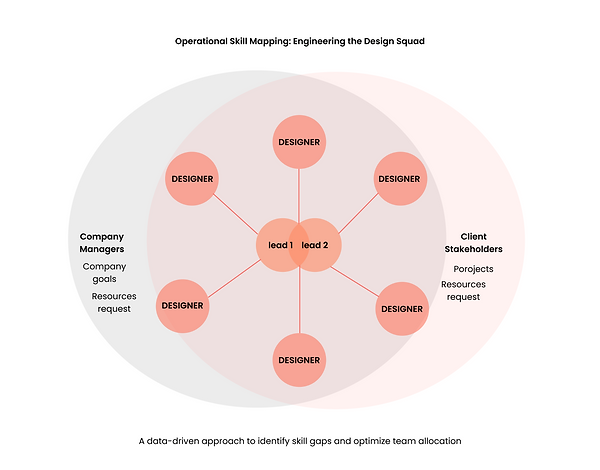
I conducted a skills-gap analysis to identify the unique strengths of each team member (Visual, Research, Interaction), ensuring everyone was assigned to the work where they could provide the most value.
Established a 'Safe-to-Fail' environment with weekly design critiques, moving the team from defensive design to collaborative problem-solving.
Co-led a cross-functional team of 6 designers, acting as the bridge between client expectations and team capacity.
OPERATIONAL
Talent Mapping: Aligning Expertise with Complexity
To stabilize the medical ecosystem, I audited the collective skills of our 8-member squad. By identifying high-proficiency leads in System Architecture and Visual Logic, we optimized task allocation, ensuring the right specialist was on the right task.

Re-establishing Client Trust & Team Capacity
I used individual skill assessments to have honest career conversations. We moved beyond UI execution into strategic logic
The Result: Scaling through Impact
The results were immediate and measurable. Because the client saw a more organized and confident team, they doubled their investment in us."
-
Team Expansion: Scaled from 4 to 6 core designers (and eventually 8) due to increased reliability.
-
Productivity: Each team member moved from handling 0.5 projects to 2 simultaneous projects.
-
Capacity: We went from managing a handful of tasks to overseeing 16 simultaneous projects with 0% operational downtime.
The team's performance metrics directly influenced the client's decision to expand our headcount by 50%. By standardizing our deliverables and leveling up individual designer confidence, we moved from being 'ticket executors' to a strategic design unit managing simultaneous projects.
IMPACT & OUTCOMES
Scaling Capacity through Design Ops

The success of the Kaiser Permanente migration wasn't just measured by the tools we used, but by the speed and precision of our delivery. By combining data-driven mentorship with a robust Design System architecture, we transformed the team’s output.
My co-leadership focused on removing the friction that slows designers down. By establishing a 'Single Source of Truth' and automating our hand-off documentation, we empowered a team of 6 to act with the efficiency of a much larger department, successfully merging and localizing over 200 medical components in a record time of two months.
Focus Area
Strategic Outcome
Delivery Velocity
200+ Components in 2 Months: Successfully audited, migrated, and documented the entire medical library with 0% operational downtime.
Team Capacity
Efficiency Doubled: Scaled from handling 8 to 16 simultaneous projects by optimizing individual workflows and reducing design debt.
Team Growth
50% Headcount Increase: Earned client trust to expand the squad from 4 to 6 designers based on improved performance metrics.
Operational Trust
Sustainable Governance: Launched the Experience Hub, ensuring that new designers could onboard and deliver medical-compliant work in days, not weeks.